
Hungayono Forest
Hungayono is the name of a rainforest area located in Gorontalo. Hungayono is included in the Bogani Nani Wartabone national park area, precisely in Bone Bolango Regency Gorontalo Province. The Hungayono rainforest is currently the best place for those of you who want to observe endemic animals and birds on Sulawesi Island. Endemic animals such as the Tarsius Spectrum are very easy to see in the Hungayono Forest area. If in the Tangkoko conservation forest Tarsius Spectrum can only be seen and observed in the morning and evening, in the Hungayono forest they can be seen and observed in the day. Also in the Hungayono Forest there are endemic black monkeys from seven species of black monkeys on the island of Sulawesi. The black monkey that lives in the Hungayono Forest is Macaca Nigrescens. Black Macaca Nigrescens at a glance is similar to Macaca Nigra black monkeys in the Tangkoko Conservation forest because it has a crest, but what makes them different is the color of the fur. If the Macaca Nigra Monkey is black, Macaca Nigrescens has a brownish fur color. In the forest of Hungayono the black monkey Macaca Nigrescens can be found in groups of about 20-30 with 1 of their leaders.

In the Hungayono forest we can also find endemic Kus Kus bear Sulawesi (Ailurops Ursinus). Kus Kus Bear Sulawesi has a long and strong tail to use when climbing trees to look for their food. Kus Kus Bear Sulawesi has round eyes and small ears and a fairly thick coat of gray. For Kus Kus Bear Sulawesi, a female has a sac which is a place to carry their child. In addition, in the Hungayono Forest we can also find Sulawesi Island endemic birds such as the Maleo Bird (macrocephalon maleo). Maleo bird itself is a bird that can only be found on the island of Sulawesi. These birds have a habit of storing their eggs in sand or soil with a depth of 60 cm – 1 m when laying eggs. This is done to avoid predators who will prey on their eggs. When the Maleo bird’s eggs hatch, the maleo chicks also have to survive to get out of the ground and will fly right out of the ground.
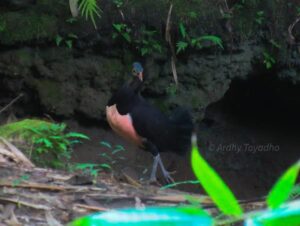
Hungayono Forest in Gorontalo Sulawesi Indonesia is one of the best forest in Sulawesi for those of you who want to observe wildlife and birds. Located in the Bogani Nani Wartabone Gorontalo National Park area, precisely in Bone Bolango Regency, Gorontalo Province, the Hungayono forest is an endemic ecosystem of animals and birds typical of Sulawesi. For you fans of birds, Gorontalo Hungayono Forest is perfect for those of you who want to enjoy and observe the birds typical of Sulawesi Island. Maleo bird (Macrocephalon Maleo) is an endemic bird that you can easily find and observe in the Hungayono forest of Gorontalo. In the Hungayono Gorontalo forest there is a Maleo bird conservation site sponsored by WCS Indonesia (Wildlife Conservation Society Indonesia). Besides Maleo birds, we can also observe Sulawesi’s endemic hornbills, Knobbed Horbill and Sulawesi Dwarf Hornbill. You can also easily see Kingfisher endemic birds in Gorontalo Hungayono Forest such as Sulawesi Dwarf Kingfisher, Lilac Kingfisher, Green-back Kingfisher, and Black-capped Kingfisher.
Sulawesi’s endemic birds that are active and foraging above ground can also be found in Hungayono forest Gorontalo such as Sulawesi Pitta, Hoded Pitta, Red-backed trush, Sulawesi babbler, Sulawesi Ground Dove, Stepen’s dove. Sulawesi Island endemic birds that are active and foraging on trees can also be seen in the Hungayono Gorontalo forest such as Sulawesi Cuckoo Dove, Green imperial Pigeon, Sombre Pigeon, Obholser’s Fruit Dove, Black-naped Fruit Dove, Sulawesi Malkoha, Bay Coucal, Black-napped Oriole, Ashy Woodpacker, Spot-tailed Sparrowhawk, Sulawesi Racquet-tail, Great-billed Parrot, Pale-blue Monarch, Sulawesi Crow, Grosbek Myna, White-necked Myna, Sulawesi Jungle Flycatcher and Sulawesi Brush Cuckoo. In addition, we can also find birds that are active at night in Hungayono Forest Gorontalo such as Sulawesi Scops Owl and Northern Boobook.